


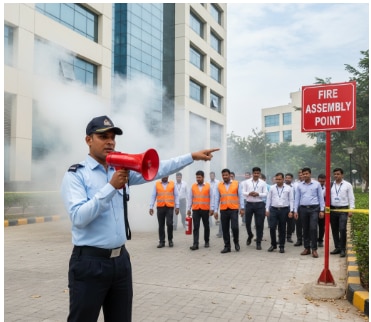
 Sample Fire Drill Scenario for Security Guards
Drill Title: Operation "Clear Halls" - Q3 Fire Evacuation Drill
Date: [Date of Drill]
Time: 10:30 AM
Location: [Your Building/Company Name], Main Office Building
1. Drill Objectives:
To test the effectiveness of the fire alarm system and communication protocols.
To evaluate the response time and efficiency of the security team and designated fire wardens.
To ensure all personnel can evacuate the building in a safe and orderly manner to the designated assembly point.
To practice accounting for all personnel post-evacuation.
To identify any weaknesses in the current emergency evacuation plan.
2. Scenario:
A fire has started in the electrical room on the 2nd floor (Room 214) due to a simulated electrical fault. The fire is generating a significant amount of smoke, which has activated a smoke detector. One of the primary stairwells (Stairwell A) is compromised by smoke and is unsafe to use.
3. Participants & Roles:
Security Supervisor (Drill Coordinator): Oversees the entire drill, initiates the scenario, and times the evacuation. Does not directly participate in the initial response unless required to guide the team.
Security Guard - Control Room (Guard 1): Monitors the fire alarm panel, makes building-wide announcements, and communicates with the Security Supervisor and emergency services (in a real event).
Security Guard - Roving Patrol (Guard 2): Acts as the "discoverer" of the fire. Responsible for initial response and communication.
Security Guards - Lobby/Access Points (Guard 3 & 4): Manage the flow of evacuees, prevent re-entry into the building, and direct people to the assembly point.
Designated Fire Wardens (Employee Volunteers): Responsible for sweeping their designated floor/area to ensure everyone has evacuated, assisting individuals with mobility issues, and reporting to the Security Supervisor at the assembly point.
Employees: All building occupants are expected to participate by evacuating in an orderly manner.
4. Sequence of Events:
| Time | Action | Responsible Party | Notes |
| 10:30:00 AM | Drill Start: Security Supervisor discreetly places a "Simulated Fire" sign on the door of Room 214 and uses a non-toxic smoke machine (if available and safe) to simulate smoke near a detector. | Security Supervisor | Supervisor starts a stopwatch. |
| 10:31:00 AM | Alarm Activation: The smoke detector in the 2nd-floor corridor activates the building's fire alarm system. | (Automated System) | |
| 10:31:00 AM | Initial Response: The alarm sounds in the Security Control Room. Guard 1 acknowledges the alarm and identifies the location of the activated detector on the fire panel. | Guard 1 (Control Room) | |
| 10:32:00 AM | Communication & Announcement: Guard 1 immediately dispatches Guard 2 to investigate the alarm. Guard 1 then makes a building-wide announcement: "Attention, attention. A fire alarm has been activated on the 2nd floor. Please evacuate the building immediately using the nearest safe exit. Do not use the elevators." | Guard 1 (Control Room) | |
| 10:33:00 AM | On-Scene Report: Guard 2 arrives at the 2nd floor, sees the "Simulated Fire" sign and simulated smoke, and immediately radios the Control Room: "Control, this is Guard 2. We have a confirmed fire scenario on the 2nd floor, electrical room. Stairwell A is blocked by smoke. Initiating evacuation of the 2nd floor." | Guard 2 (Roving) | |
| 10:33 AM - 10:40 AM | Evacuation: Employees and Fire Wardens begin evacuating. Fire Wardens sweep their areas, checking offices, restrooms, and common areas, and then report their floors as "clear" to security guards as they exit. Guards 3 & 4 are positioned at the main exits to guide personnel and prevent re-entry. | All Employees & Fire Wardens, Guards 3 & 4 | Guards direct evacuees away from the building and towards the designated assembly point. |
| 10:40:00 AM | Assembly Point & Headcount: All personnel gather at the primary assembly point. Fire Wardens report to the Security Supervisor, providing the status of their floors and the names of any missing individuals from their departments. | All Personnel, Fire Wardens, Security Supervisor | |
| 10:45:00 AM | Drill Conclusion: Once all personnel are accounted for (or a search for any missing individuals is simulated), the Security Supervisor announces the conclusion of the drill. | Security Supervisor | Supervisor stops the stopwatch and records the total evacuation time. |
| 10:46:00 AM | "All Clear" Announcement: Guard 1 makes a final announcement: "Attention, attention. The fire drill is now complete. An 'all clear' has been given. You may now safely return to the building. Thank you for your cooperation." | Guard 1 (Control Room) |
5. Post-Drill Debrief (11:00 AM):
The Security Supervisor will hold a mandatory meeting with all security personnel and Fire Wardens. The following points will be discussed:
Total evacuation time: Was it within the target time (e.g., under 15 minutes)?
Performance of the alarm system: Did it function as expected?
Communication: Was communication between guards and with building occupants clear and effective?
Challenges: Were there any issues encountered? (e.g., people not taking the drill seriously, confusion about exit routes, issues with assisting individuals).
Areas for Improvement: What can be done better next time? This could include additional training, clearer signage, or updated procedures.
A formal report will be written up by the Security Supervisor and submitted to management.
Sample Fire Drill Scenario with Complexities: -
Scenario: A simulated fire breaks out on the 3rd floor of an office building during a busy workday.
- Test security guards' response to a complex fire emergency.
- Evaluate communication protocols and adaptability to system failures.
- Assess effectiveness in assisting injured persons and managing blocked exits.
- Simulated Event: A smoke generator is activated in the 3rd-floor pantry, simulating a fire due to a faulty electrical appliance. A security guard on patrol in the area observes smoke and initiates the fire alarm.
- Complexity 1 (Communication System Failure): Immediately after the alarm, the main public address system malfunctions, preventing centralized announcements.
- Security Guard Action:
- The first responding guard immediately activates the nearest manual fire alarm and calls the fire control room via a two-way radio.
- Security guards on other floors, upon hearing the alarm, begin immediate floor-by-floor evacuation using hand signals and clear verbal instructions, as the PA system is down.
- Complexity 2 (Blocked Exit): A prop or designated area on the main stairwell leading from the 3rd floor is marked as "blocked due to falling debris," simulating an obstructed primary exit route.
- Security Guard Action:
- Guards directing evacuation on the 3rd floor immediately identify the blocked exit and redirect evacuees to an alternate, designated fire escape route on the opposite side of the building.
- They ensure clear signage or verbal instructions guide individuals to the alternative route, and manage potential congestion calmly.
- Complexity 3 (Simulated Injury): A designated "volunteer" on the 2nd floor simulates a fall during evacuation, resulting in a minor "injury" (e.g., sprained ankle, requiring assistance).
- Security Guard Action:
- A designated security guard or fire warden, trained in first aid, assesses the injury and provides immediate assistance, prioritizing safe evacuation if possible, or moving the injured person to a safer spot if evacuation is delayed.
- They communicate the location of the injured person and the need for medical assistance to the command center or arriving emergency services.
- Security Guard Action:
- All evacuees are guided to the designated fire assembly point outside the building.
- Fire wardens and security guards conduct a roll call using pre-prepared checklists to account for all personnel and report any missing individuals to the command center.
- Security personnel cordon off the area around the building to maintain a safe distance and prevent re-entry until an "all clear" is given by the fire department.
- Security Guard Action:
- Participate in a debriefing session with the fire safety team and emergency responders to discuss the drill's effectiveness, identify areas for improvement, and document lessons learned.


